
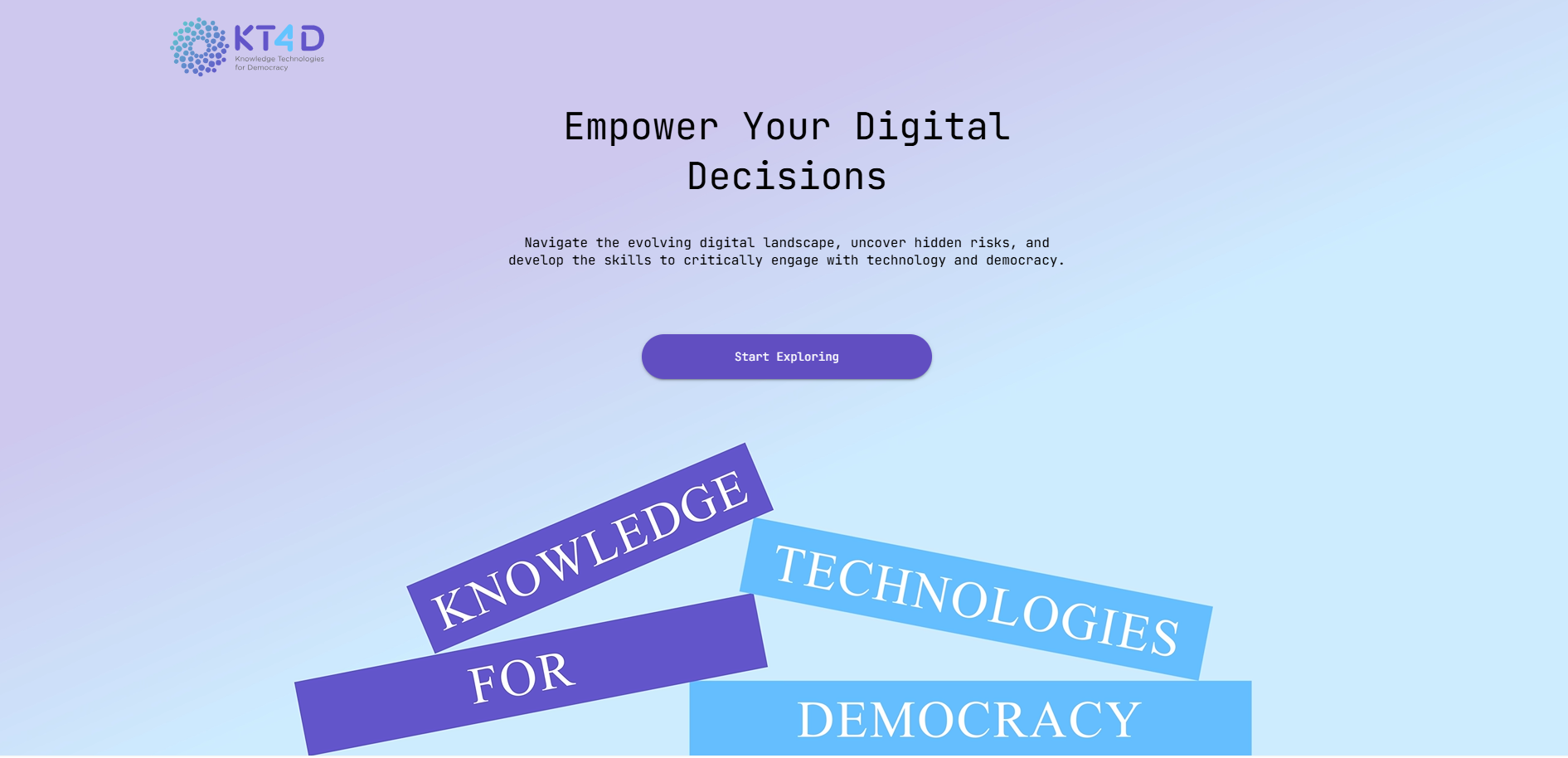
This section presents the KT4D serious game, an interactive tool to engage players with ethical dilemmas surrounding advanced knowledge technologies.
Protect citizens from potential negative impacts of AI
The KT4D serious game is a decision-making game, built around a national leadership scenario, where the user navigates a series of ethical challenges depicted through 10 dilemmas related to advanced knowledge technologies and their governance style. Its objective is to offer an interactive educational/infotainment experience that allows individuals to play and use critical digital literacy concepts. It is also to offer a learning experience about decision-making dynamics related to advanced knowledge technologies and governance. Throughout the game, the player has to solve different ethical dilemmas related to AI issues and their consequences. The goal of these materials relates to protecting citizens from the possible negative impacts of advanced knowledge technologies on fundamental rights and democracy. It aims to empower users, while enhancing civic participation and democracy.
Use Case Validation
The validation of the Serious Game revealed a high level of interest and engagement among participants, particularly thanks to the dilemmas, which successfully sparked meaningful debate. However, several structural and usability challenges emerged. Firstly, there were some grammatical errors. A recurring issue was capitalisation: the translations followed English rules, which led to Spanish sentences containing unnecessary or odd capital letters. These should be corrected according to Spanish conventions.
Another common point was visibility and continuity: although the game asks users to choose a name and identity at the beginning, these elements barely appear later, which reduces immersion. Many users, including citizens and students (18-year-olds), reported that the game required significant time to complete, and the text-heavy format demanded sustained concentration, with some vocabulary perceived as overly complex. In fact, we were not able to carry out the validation of the Serious Game with the CSO due to insufficient time and comprehension issues.
Due to the perceived complexity of the two explainers, the Serious Game was not conducted with this group. The dual-option dilemmas also felt limiting for several participants, who noted that real-life situations often require more nuance. In general, it was well received as a concept, both by the citizens and students and teachers. The sessions revealed that the game was not fully adapted to all user groups, with some participants struggling with text density, terminology, or navigation. Based on these insights, we decided to focus the game as a targeted tool for specific groups, such as university students, teachers, or other users with higher digital literacy. This approach allows the game to be used effectively in educational or structured settings, ensuring that it delivers meaningful engagement and learning outcomes while remaining accessible and manageable for the intended audience.
In regards to the survey, participants highlighted the serious game (especially students and citizens, as the CSO group was not able to play) as the most engaging element of the workshop, appreciating its depth and its ability to simulate real-world decision-making, particularly in relation to governance and regulation of technology. The workshop encouraged reflection on real-life consequences of decisions, linking theoretical concepts to societal and ethical dilemmas. Participants noted that the materials could be applied across different topics, as well as the collaborative aspects, such as discussions and reaching consensus with others.