
There is a way for the European Union to break the United States – China binary when it comes to governing AI.
Artificial Intelligence (AI) development is currently outpacing public deliberation, allowing democratic oversight to slip as power concentrates in the private sector. At the same time, AI poses significant risks and implications for our democratic systems, processes, and agency. With geopolitical competition over AI intensifying, policies should actively reclaim technological innovation for the democratic and public good.
This poses a foundational problem for democratic AI governance: how to address the broad risks of AI to democracy while realising its opportunities for strengthening democratic processes?

We cannot protect democracy through regulation alone when the digital infrastructure that underpins the modern public sphere is owned by private platforms. This framework guides how to embed democratic values into AI governance across the lifecycle of systems.
Accepting this challenge, we propose a holistic approach to democratic AI governance. This policy brief introduces a framework that embeds democratic pillars — participation, freedom, equality, transparency, knowledge, and the rule of law — across the entire AI lifecycle. We argue that democratic safeguards cannot wait until an AI system is already deployed and in use. Instead, they must cut across every layer of governance, from the initial design and data collection to the very infrastructure underlying the technology.
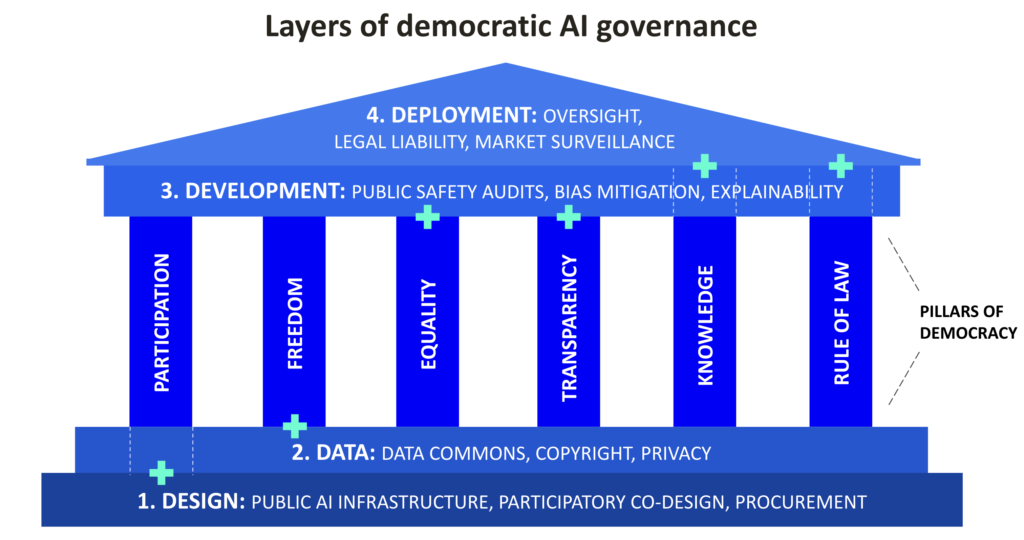
The framework is particularly relevant to the European Union, which currently lacks the sovereign AI infrastructure necessary for democratic governance. To implement the framework for democratic AI governance in the EU context, we outline a policy roadmap for European policymakers. The roadmap is organised into a sequence of short-, mid-, and long-term policy actions, which support the goal of AI strengthening democracy by 2035:
- Short-term 2026–2028: Enforcing regulation & building public AI infrastructure
- Mid-term 2029–2032: Democratic adoption
- Long-term 2033–2035: Exercising AI sovereignty
Our research offers 18 concrete policy recommendations, applied over five AI policy tracks, to facilitate the implementation of the framework:
- regulatory enforcement
- public AI infrastructure
- investments and innovation
- AI literacy
- research and standards
The recommendations focus on short-term action (2026-2028) and provide practical guidelines for experts and policymakers on democratic AI governance.